Healing Haunted Histories

Our exclusive interview with Elaine Enns, the author of Healing Haunted Histories: A Settler Discipleship of Decolonization (2021).

Radical Discipleship: Elaine, I cannot believe it has been five years since you published Healing Haunted Histories: A Settler Discipleship of Decolonization. I continue to hear from friends and comrades who rave about your book. Just last week, in one of the men’s groups that I facilitate, one brother recommended it to the rest of the crew! For folks who might be unfamiliar, could you give us a brief synopsis of the book? Also why did you write it and who did you write it for? 

Elaine Enns: Tommy, thank you for this opportunity to be in conversation with you.  I continue to be humbled and gratified by all the folks using and promoting Healing Haunted Histories

A synopsis: Most of us white settlers believe that colonization is something that happened in a distant past that doesn’t concern us; has nothing to do with our own family or history; and/or is too complicated for regular people like us to understand. The truth is that colonization has a politics, economics, culture and a spirituality that runs right through each one of us who reside on Turtle Island. Healing Haunted Histories is about developing a sense of “response-ability” (an intentional double entendre) to an ongoing historical project that we are socialized to keep at arm’s length, or worse, to dismiss.

Ched and I developed a “landlines-bloodlines-songlines” framework that instructs and empowers us to examine—compassionately but critically—how our family benefited from, has been implicated in, and harmed by colonization. 

Landlines looks at how, from the beginning of our ancestral migrant journeys, our people were pushed and pulled by macro forces of boom and bust (such as war, economics, famine, or racial politics), and how different people came (or were forcibly brought) under vastly different circumstances. We encourage readers to research where and how their ancestors arrived in North America; what privileges or entitlement they experienced (or not); and what impacts their settlement had on Indigenous peoples. We also need to reckon with our own resettlements across the landscape, whether in pursuit of adventure, education or jobs. How do these movements essentially reproduce unconsciously colonial entitlement to “help ourselves” (in both meanings of that phrase) without relationship or permission, while remaining ignorant of the history, culture and present situation of Indigenous peoples we continue to displace.

Bloodlines work is about:

  • How we were shaped by the loss or distortion of our ethnic identities through assimilation into whiteness, and how we internalize attitudes of white supremacy while holding onto myths of settler innocence and nobility;
  • Looking at intergenerational patterns of privilege, moral injury and trauma that we have inherited and by which we’ve been shaped and misshaped;
  • And the narratives and myths into which we have been socialized by family, community, and dominant culture, which tell only part of the story while distorting or silencing problematic aspects.

And Songlines are the liberatory traditions of faith, courage, service, neighborliness and mutual aid that also inhabit parts of our ancestral story. These help animate and support our own commitments to restorative solidarity and justice. 

While our focus is how this work interfaces with the original inhabitants of this land, the same work is required concerning legacies of enslavement and systemic racism that have similarly impacted both self and society. We have facilitated many workshops where white settlers use this process to address enslavement in their ancestral history and where BIPOC participants use the framework and adapt it to their context.  The book concludes by focusing on practices of a decolonizing discipleship, illustrated by examples of individual, congregational, denominational and political efforts that experiment with relationship building, solidarity, reparations and repatriation.

I started researching this project in 2010 because I wanted to understand the impact of intergenerational trauma in my community and how it was hampering our ability to see and respond to the historical and current realities of our Indigenous neighbors in the prairies.  Ched and I wrote this book primarily for white settlers, but many different groups are experimenting with the model, taking what is helpful and adapting it to their contexts and questions. We have been workshopping this material for ten years, and it has been a transforming journey of deepening and broadening our discipleship. 

RD: Elaine, I’d love to hear some of your own testimony. How has this ancestral work healed and liberated you?

EE: Over the last dozen years, I have taken a deep dive into how the ancestral stories we carry influence and shape us.  I am particularly interested in how—for those of us who are descendants of white settlers—the narratives, myths and half-truths with which we grew up and the impact of intergenerational moral injury, form and de-form us. The work of Healing Haunted Histories is to examine these compassionately yet critically, in order to become more “response-able” to the work of reparative justice.

The seeds of my involvement in this ancestral work were planted by my experience of three teenage girls.

                       i.            Over a century ago, in December 1918, my maternal grandmother endured a home invasion in Osterwick, Ukraine during the Russian Revolution, when anarchist soldiers commandeered her house for two weeks over Christmas. She was fourteen when, with her sister and girl cousins, she was hidden up in the attic, while her mother (my great-grandmother) fed, clothed and bandaged the wounds of the hostile soldiers. This was just one episode in a continuous climate of violence during this period.

                     ii.            When I was thirteen, I knew something horrible had happened to my grandparents, and wanting to know more, I interviewed this grandmother. She began by speaking about the beauty and abundance growing up in Ukraine, but as her account approached her teenage years, she began to weep and could not continue. Because I knew her only as a joyful person who was full of laughter, seeing her cry left an indelible impression on me. I later came to understand such symptoms of unresolved trauma, which has been intergenerational for my family and many others in our Russian Mennonite community. 

                   iii.            Third, in my final year of college in Winnipeg, MB, I volunteered with the Big Sisters/Little Sisters program. I was paired with a thirteen-year-old Cree girl who had just been released from juvenile detention after three years. Her “crimes” had been sniffing glue, stealing food and clothes, and getting into fights. Though I had no race or economic analysis at the time, she helped me see that the Criminal Justice System was unable to address the impacts of injustices on this Indigenous child. This experience was my first tutorial in the hard truths of colonization, and began to raise deep questions about how her ancestors had been displaced by mine on the Canadian prairies. This compelled me to begin exploring restorative justice, first in the criminal justice field, and later as a response to historical violations.

As I considered the latter, I realized that while I heard in my family and community about the violence my grandparents’ generation experienced, I never learned about the genocide of Indigenous peoples in Saskatchewan. These three experiences laid a foundation for me to wrestle with decolonizing the narrative I inherited from my Mennonite subculture.

In my research into these issues, I came upon the critical lens that Unangax scholar Eve Tuck calls “Settler Moves to Innocence.” In our book we outline ten such strategies through which we settlers typically seek to exonerate ourselves from responsibilities for and to the past and present violence of colonization. For example, we consciously practice what Canadian scholars call “agnosia”—a kind of “aggressive unknowing” which justifies our ignorance concerning historic and continuing injustices: we neither want to know nor care that we don’t know.  Thisis rooted in the pervasive ideology of ahistoric individualism (e.g. “I didn’t own any slaves”; or “my family didn’t displace anyone – they bought their land fair and square.”) We imagine that we are free-floating entities, unaccountable to what has preceded us and dissociated from patterns and systems that have benefitted us.

Another strategy is a willingness to acknowledge that violence may have occurred, but was never intended, so there is no need to take responsibility or make amends. Anti-racist educator Robin DiAngelo says that such distinctions between intent and impact is the “foundation of white fragility.”Nor are folks in progressive communities immune; for example, we think by adopting the right talking points and critical consciousness we have exonerated ourselves from doing the hard work of making things right.

   In the final chapters of Healing Haunted Histories we outline four practices of restorative solidarity that can nurture our healing and liberation:

  • Re-schooling the colonial legacy and identity we have inherited through building literacy, critical analysis and moral imagination;
  • Relationship-building with Indigenous communities (especially our neighbors), to de-abstract the issues;
  • Restorative actions that support work for Indigenous Justice; and
  • Reparative experiments—both personal and political—with resources we own or influence.

I have experienced how such practices of a settler discipleship of decolonization can contribute to healing of our haunted histories and to the liberation of our hostage future. I have become far more attentive to:

  • how the land holds stories in both my homeland of Saskatchewan and my adopted land of California (my landlines work);
  • my own ethnic community’s costly assimilations, blind spots and moral injury (my bloodlines); and
  • all the ways our faith traditions can animate us to heal parts of us that have been deformed by colonization—from scripture to song and from pilgrimage to protest—which give us courage to take concrete steps towards reparative justice (my songlines).

RD: As you know, most people read books like Healing Haunted Histories individually. Tell us why reading your book together can be so transformational – and how your new group study resource (Throughlines) can help with this.

EE: It is both countercultural and counterintuitive to do this work because we white North Americans have been socialized to deny past injustices, and to shrug off responsibility for present inequities. Though each of our stories has different particularities, all of us have grown up in a world impacted by the history and continuing structures of colonialism. But we are intimidated to take this on, because it is so deep and wide in its implications. Working the LBS process collectively allows group participants to name the resistances that arise within and among us, share and probe what we are learning by comparing notes, and encourage one another’s steps deeper into decolonizing discipleship. This reduces our sense of being overwhelmed in our implication and isolated in tackling such big and taboo subjects. 

We believe that doing decolonization work in community functions to deprivatize our anxieties (since we are all facing different types of hauntings, moral injury and/or trauma); and communitize our imaginations concerning how to do genealogical work (approaching our families and facing difficult narratives) and how to take next steps in each of the four restorative solidarity practices outlined in the book (see above). Groups can become a safe container of encouragement and empathy as well as challenge and accountability. Some participants decide on restorative solidarity practices to do together, and some continue to meet to accompany one another deeper into reparative praxis.

For a decade we’ve workshopped HHH with in-person and online groups small and large. This led us to create the newly releasedThroughlines companion, a ten-session guide that resources processes of study and practice.  It includes:

  • a 49-page Facilitator’s Guide (PDF), step-by-step instructions to lead a group through difficult but animating conversations and commitments;
  • a 27-page Participant Workbook (PDF), offering mapping exercises and worksheets to help participants learn the Landlines of their settlement, decode family myths and find Songlines that inspire and sustain resistance and solidarity; and
  • Nine Key Concept Videos: Links to downloadable files for 15- to 30-minute illustrated summaries, narrated by author Elaine Enns.

Steve Taylor, United Methodist Church Home Missioner and Director of Antiracist Discipleship and Beloved Community for his denomination in North Carolina, recently facilitated an HHH group using Throughlines, and offered these reflections:

It was a shared journey of discovery, truth-telling, and transformation. Together we engaged the stories that shape us: the lands we inhabit; the peoples our ancestors encountered, displaced, or benefited from; and the systems of colonization and white supremacy that continue to de-form our lives and communities today.  We learned that decolonization and healing are not solitary accomplishments, but practices we learn and live into alongside one another as we move beyond abstraction and into embodiment. We listened deeply, spoke honestly, and learned to be accountable to one another as we discerned and continue to discern faithful steps toward reparative action.

So on this fifth anniversary of HHH’s publication, we encourage RadicalDiscipleship.net readers to consider forming a group using Throughlines to deepen their own decolonizing discipleship. Here are two discount codes to facilitate this:

  • a 40% discount code for Throughlines: RDSAVE40 (for a group of nine sharing the cost it would be just $20 per participant) order here;
  • 40% discount for Healing Haunted Histories: order directly from Wipf & Stock and enter HHHGRP26 at check-out. 

The Madness of Grace in a Fallen World

A new online course offering from The Alternative Seminary. Tuesday evenings, July 7-28 (7:00 – 9:00 p.m).

The Southern writer Flannery O’Connor once offered a wry variation on a theme of Jesus: “You shall know the truth and the truth shall make you odd.”  Her fiction, set in her rural Southern culture, is a world of oddness, weirdness, madness, misfits and murderers, corrupt preachers and moralistic hypocrites.  It is also a world of the sometimes harsh and shocking intrusions of grace into flawed and fractured humanity.

The Alternative Seminary is offering an opportunity to explore O’Connor’s fiction in an upcoming online course.  For four weeks, we will read and discuss some of her most challenging stories. We will pay particular attention to what she might be saying to us in these strange and troubling times – which includes wrestling with her complex views and fictional portrayals of race.  Join us for some provocative (and fun) literary and theological adventures.

The course will be led by Will O’Brien, coordinator of the Alternative Seminary.  The cost for this course is $50 (or whatever you can afford).  To register, go to https://bit.ly/FlanneryOConnor26

For more information contact Will O’Brien at willobrien59@gmail.com or 267-339-8989.

The Alternative Seminary is an informal program of biblical and theological study and reflection designed to foster an authentic biblical witness in the modern world. www.alternativeseminary.net

Always Conditional

From Nerdeen Kiswani, a Palestinian Muslim and founder of Within Our Lifetime. Re-posted from social media.

The U.S. left really does not understand the damage it is doing to the Palestinian liberation struggle.

No serious Palestinian engaged in the struggle for liberation, whether in Palestine or in exile, would ever condemn or denounce the right of Palestinians to resist occupation, apartheid, and genocide by any means necessary.

Yet we are increasingly told that people who do exactly that are part of the movement, and that anyone who challenges them is divisive, unreasonable, or an “op.”

What this actually does is place Palestinians who remain committed to our political principles in the crosshairs of everyone: Zionists, the right wing, the state, and now even sectors of the left. It marginalizes Palestinians, portrays us as extremists for upholding positions that have always been central to our national liberation struggle, and pressures us to abandon our own political consensus in order to accommodate American political sensibilities.

The result is the isolation of Palestinians from our own movement.

Continue reading “Always Conditional”

Interfaith Action for Palestine

The Interfaith Action for Palestine (IAP) is bringing together a coalition of faith-rooted activist organizations for a critical intervention this summer: we’re coming together to counter Christians United for Israel (CUFI) — the largest “pro-Israel” organization in the United States — during their Annual Summit July 5-7, 2026. For more information and to register, click here.

post-evangelical

By Tommy Airey, re-posted from his Substack newsletter.

Charles Cha and I joke that we were evangelical Christians before it was cool.

In the early 90’s, we attended a bible study for high school students sponsored by Campus Crusade for Christ. It was basically a training camp for evangelizing students, teachers, administrators and coaches at our public-school campus in Orange County, California.

During our junior year, Charles and I invited friends to join us in Mr. Leander’s classroom during lunch so we could get them saved. We utilized a tract called “The Four Spiritual Laws,” which was created by Campus Crusade founder Bill Bright back in the 60’s. 

Charles had the whole thing memorized.

He used the whiteboard to scrawl out bible verses from the Book of Romans.

He drew images to show how our sin will send us straight to hell – and also how God’s grace builds a bridge to heaven for those who make a decision for Christ, whose death on the cross makes us clean.

None of our friends bought that bridge.

Continue reading “post-evangelical”

A Wilder Way

A Wilder Way: Midwifing the World to Come in an Age of Extinction is a five-day gathering at Dreaming Stone Arts and Ecology Center, August 19 – 23. Together, we will weave skill-shares, song circles, storytelling, faith narratives, and community ritual – all in service to intimacy with the land and community resilience.  There will be plenty of space for rest, reflection, informal connection, and time with (and in!) the river. Meals will weave abundant connections, integrating foraged ingredients with locally grown, storied food. Together we will experiment in creating a new/old bioregional culture attuning to the land, our bodies, the collective, and sacred presence.

Sign up early to get early bird discounts. Work-trade opportunities, partial scholarships, and payment plans are available to make each event accessible. This event will nourish your spirit, grow your skills, and widen your community.  Learn more at – https://dreamingstone.org/wilder-way/

Bones, Beads, Belonging, and the Bible: Just Where are We Standing?

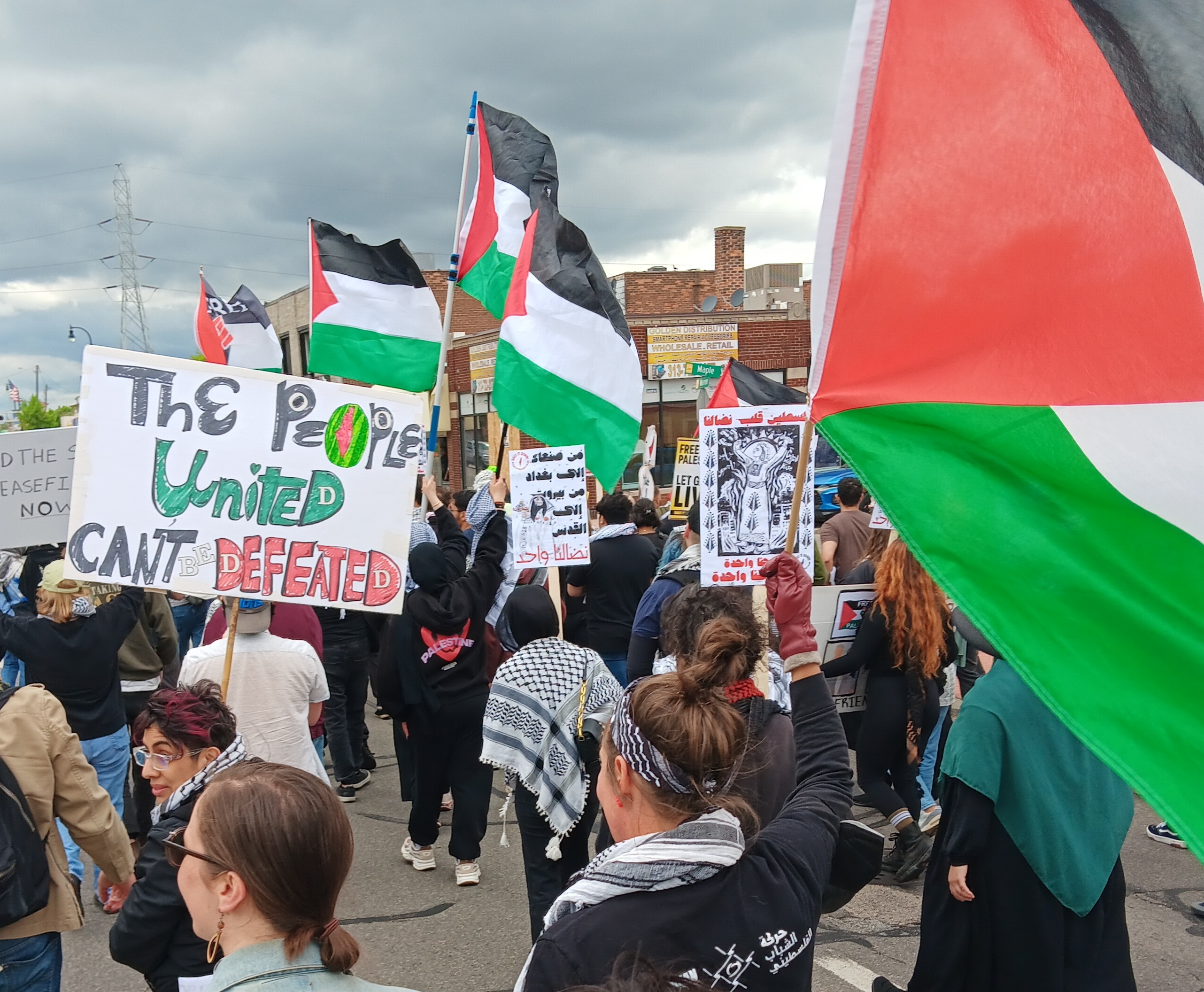
By Dr. Jim Perkinson, a sermon for St. Peter’s Episcopal Church in Detroit (03.22.2026) – pictured above at the annual Nakba Day march in Dearborn, MI (photo credit)

37 The hand of the Lord was upon me, and he brought me out by the Spirit of the Lord, and set me down in the midst of the valley; it was full of bones. And he led me round among them; and behold, there were very many upon the valley; and lo, they were very dry. And he said to me, “Son of man, can these bones live?” And I answered, “O Lord God, thou knowest. . . . 11 Then he said to me, “Son of man, these bones are the whole house of Israel. Behold, they say, ‘Our bones are dried up, and our hope is lost; we are clean cut off.’ 12 Therefore prophesy, and say to them, Thus says the Lord God: Behold, I will open your graves, and raise you from your graves, O my people; and I will bring you home into the land of Israel (Ezek 37:1-3, 11-12).

I’m going to start weird and way out—something new for me, right?  But walk with me for a moment.  We need some background.

First, I want to suggest that this story of Ezekiel prophesying to bones is ultimately about bones in the right place of burial.  And its opposite is bones out of place.  If we read just two chapters further on in Ezekiel, we encounter another strange little vignette about bones in or out of place that reads thus:

They will set apart men to pass through the land continually and bury those remaining upon the face of the land, so as to cleanse it; at the end of seven months they will make their search. And when these pass through the land and anyone sees a man’s bone, then he shall set up a sign by it, till the buriers have buried it in the Valley of Manon-gog (“Multitude of Gog”) (Ezek 39:14-15).

And what is in view here are the bones of invaders that are not just allowed to lie around wherever they fell but collected and “placed” in a particular domain previously called “The Valley of Travelers,” now renamed “Valley of the Multitude.” In fact, chapters 37, 38, and 39 of Ezekiel are actually one whole piece of interaction between Ezekiel and YHWH concerning a vision of the Great End Times Battle of Gog and Magog, much later taken up in the Book of Revelation as “Armageddon,” the Final Apocalyptic Catastrophe that supposedly ruptures history as we know it (and which right now is being used by U.S. military commanders to motivate their troops to fight Iran as a prelude to provoking the Second Coming of Jesus).  The Valley of Dry Bones episode is actually the Preface to this War scenario.  We’ll come back to that in a bit.  But for now, Ezekiel is wrestling with an implicit question: where do bones belong?

Continue reading “Bones, Beads, Belonging, and the Bible: Just Where are We Standing?”

The Nakba Never Ended

From the Apartheid-Free Newsletter put out by the American Friends Service Committee. Subscribe to it here.

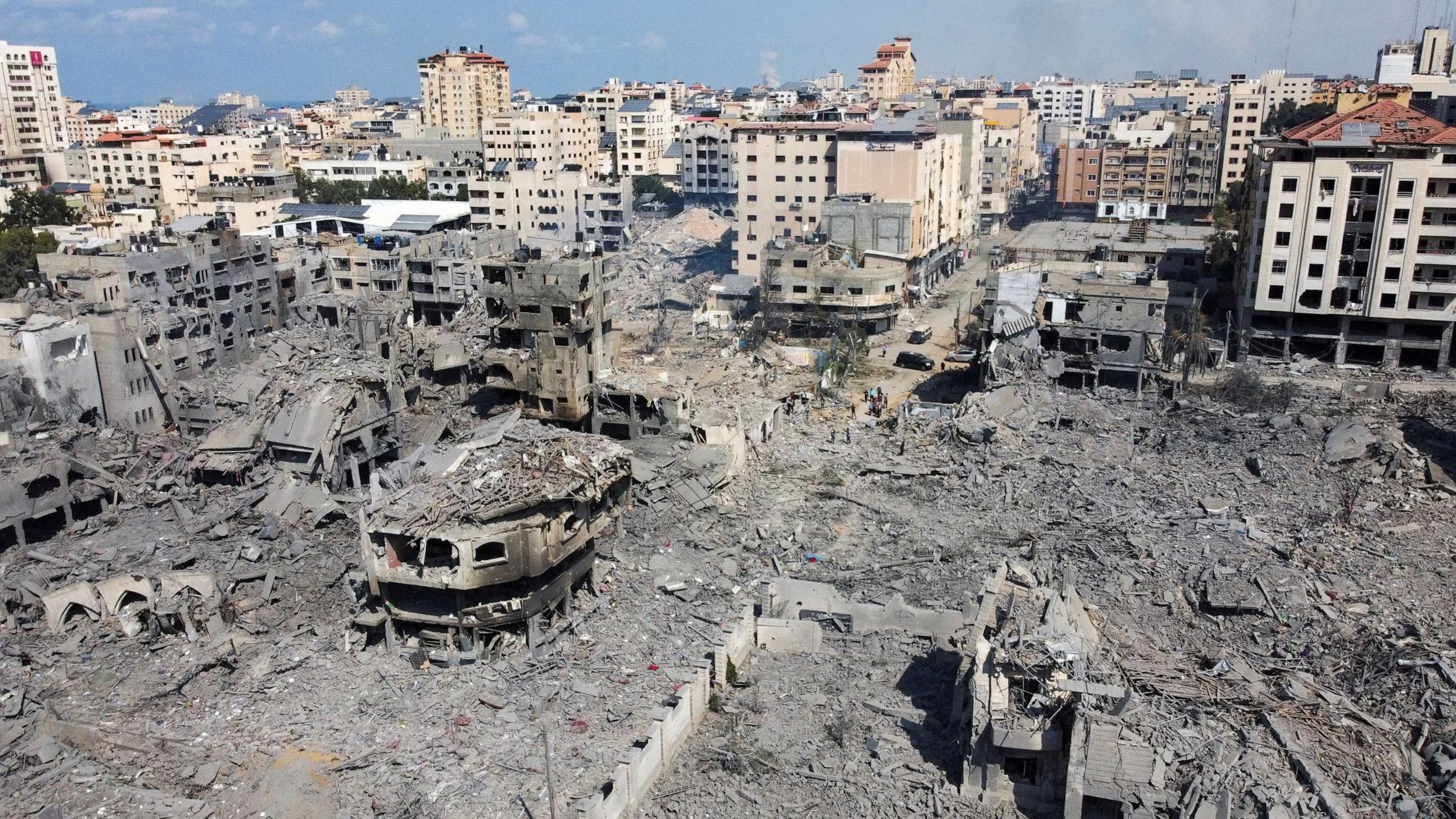
May 15 marks the 78th commemoration of the Nakba – “Catastrophe” in Arabic — which refers to the period in 1948 when Palestinians were ethnically cleansed during the creation of Israel. Between 1948 and 1950, an estimated 750,000 to one million Palestinians were forcibly expelled from their homeland by militias and the new Israeli army — about 85% of the Palestinian population. Most ended up in refugee camps in the West Bank, Lebanon, Gaza, Syria and Jordan. In addition to mass displacement, forced removal, the destruction of entire villages, and expropriation of over 4 million acres of land belonging to Palestinians, May 1948 marks the beginning of the Israeli apartheid system.Here are some of the early markers of apartheid that Israel would use to tighten its grip through ongoing occupation and erasure:
Creation of the “Transfer Committee” which oversaw the destruction of Palestinian towns and villages, repopulating them with Jews. The Zionist militias and Israeli army systematically destroyed more than 400 Palestinian towns. This map documents them. 

Passage of the “Absentees’ Property Law,” (1950) which granted the government “custodianship” over lands and property belonging to Palestinian refugees, (with no compensation for the owners). An “absentee” was defined as any Palestinian who left his or her home after November 1947, even if they remained inside what became Israel.

Passage of two additional laws — the Law of Return (1950), which still grants Jews from anywhere in the world the right to immigrate to Israel and automatically become a citizen, and the Entry into Israel Law (1952) which was designed to prevent the return of Palestinian refugees. 
It is important framing in this time to name that the Nakba never ended — that it is a structure and a system, not one event in history. You can use this month to raise education and awareness about the ongoing Nakba of the Palestinian people — a forced erasure which we continue to witness in its most recent and deadliest form in the Gaza genocide.

Splendor Within Humility

A word from our comrades at Rabbis for Ceasefire. They are posting these everyday during the 49 days of Omer, which extends from the second night of Passover to the day before Shavuot.

When involved in solidarity movements, it is important that those of us who show up as allies defer to the leadership of those most directly impacted by state violence. So, for example, in Palestinian solidarity work, it is incumbent upon those of us who are not Palestinian and not directly impacted by the actions of Israel and the U.S. to ensure that the voices of Palestinians are centered, whether in our meetings, at events, with the press, etc.

This requires humility. The humility to know that your words are not more powerful or more important than those of Palestinians. The humility to recognize that deferring to the wisdom of those directly impacted is a true act of solidarity. I see splendor within humility as a beautiful mosaic of opening the white spaces between the black letters for the voices of the most directly impacted and marginalized to speak and share their truth and stories—stories that are far too often silenced in a society that awards narcissism and charisma over truth and justice.